What is GraphOWL
GraphOWL turns the pieces of what an organisation knows (tables, files, rules, definitions) into one graph that knows what things mean, then lets people and AI agents ask it questions, check it against rules, and trust the answers.
What it does
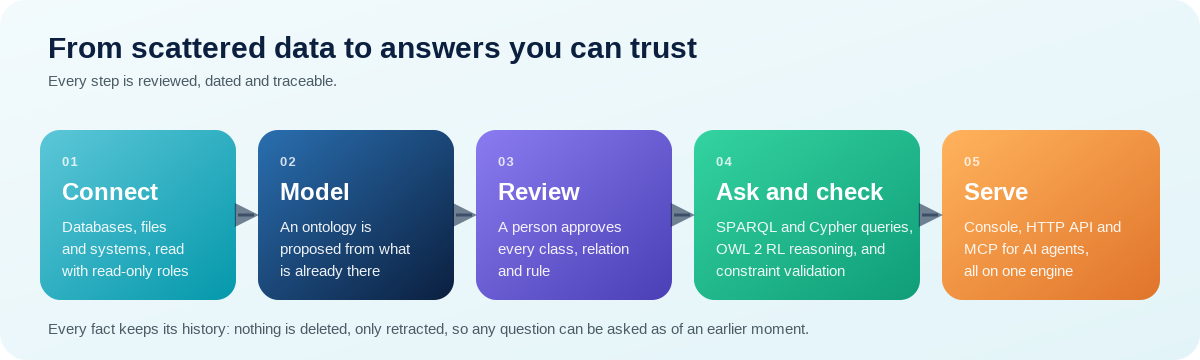
Section titled “What it does”| Connect | Read a source database through a read-only role, load files, or query a source in place as a virtual graph. |
| Model | Propose an ontology from what is already there. A person reviews every class, relation and rule before it takes effect. |
| Query | SPARQL, a documented openCypher subset, graph traversal, keyword and semantic search, over the same facts. |
| Reason | OWL 2 RL reasoning derives what follows from the model, and marks it as derived. |
| Validate | SHACL-style constraints and quality expectations check data against the model. |
| Remember | Every fact keeps its history. Nothing is deleted, only retracted. |
| Serve | An HTTP API, an MCP server for AI agents, and a console for people. |
One engine, three layers
Section titled “One engine, three layers”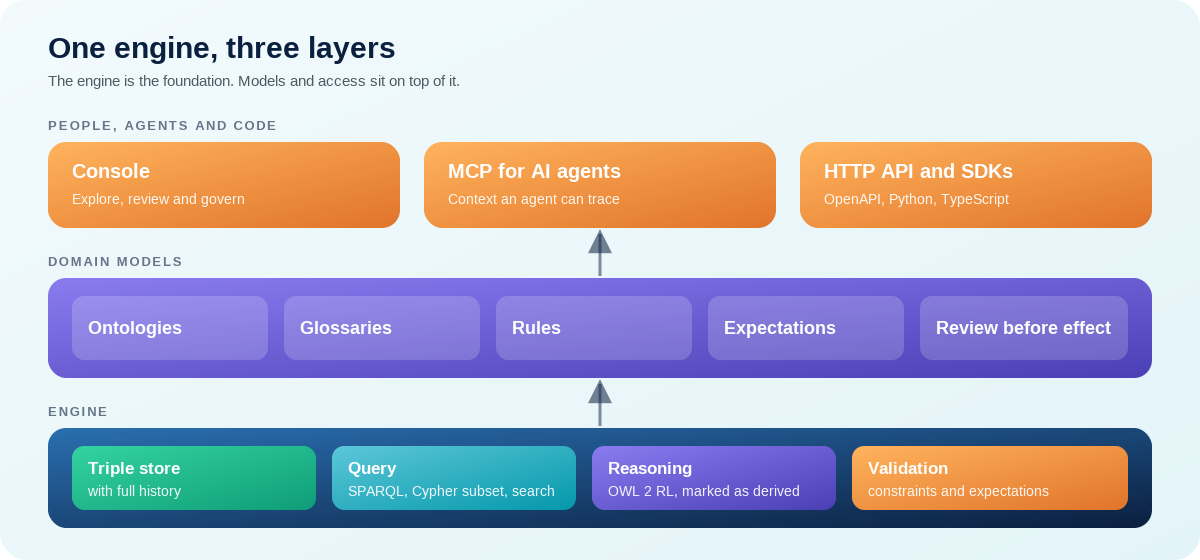
It is not a metadata catalog with a graph bolted on, and it is not tied to one industry. A data catalog, a compliance model or a product domain is one pack of models and rules on the same engine.
Many ways in
Section titled “Many ways in”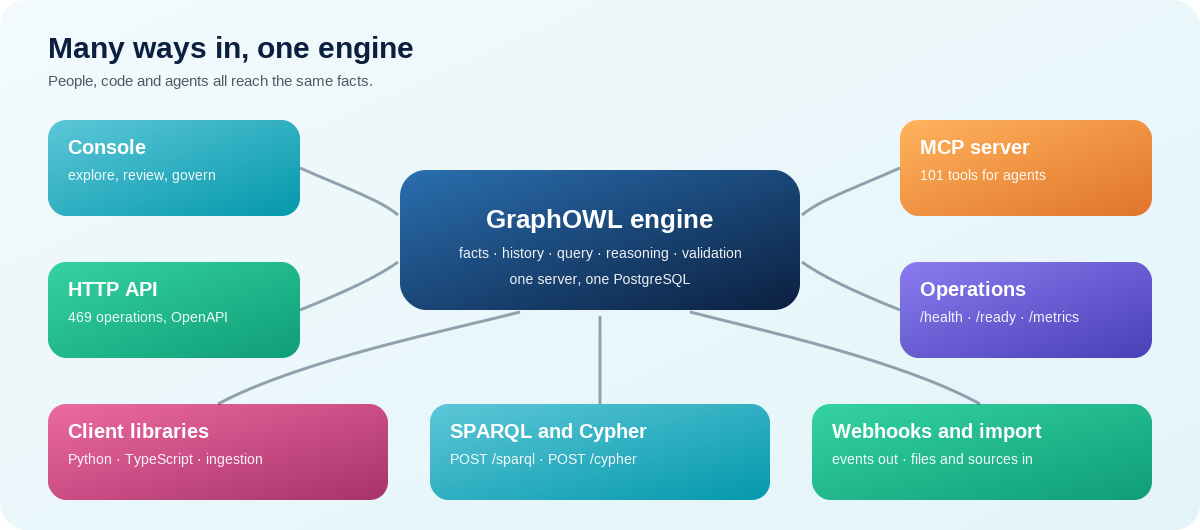
Who it is for
Section titled “Who it is for”| You are | GraphOWL gives you |
|---|---|
| A data or platform team | one graph over your databases, with definitions, owners and lineage as facts you can query |
| A domain modeller or analyst | an ontology proposed from your data that you review, then rules and constraints that check it |
| An AI-agent builder | reviewed, dated, traceable context behind an MCP server, with grants that limit what an agent may do |
| An evaluator | a live demo and a clear list of what is and is not built |
When it is not the right tool
Section titled “When it is not the right tool”- A system of record for transactions. GraphOWL reads your sources; it does not replace them. Source databases are read through read-only roles.
- Whole-graph analytics at very large scale. Traversal is bounded by design; heavy graph algorithms are not the focus. No benchmark figures are published yet.
- A drop-in replacement for another graph database. The query surface is SPARQL 1.1 and a documented openCypher subset, not a clone of any product’s dialect. See known limits.
Where to go next
Section titled “Where to go next”- See it work: the Quickstart.
- Understand it: Concepts in ten minutes.
- Check fit honestly: Known limits and Standards.
- Try a worked scenario: the dairy traceability cookbook.