

Concepts in ten minutes
Facts, and their history
Section titled “Facts, and their history”Everything in the graph is a fact: a statement about a subject, with where it came from and when it became true. Facts are never overwritten or deleted. A change retracts the old fact and adds a new one, so you can ask what was true at an earlier moment.
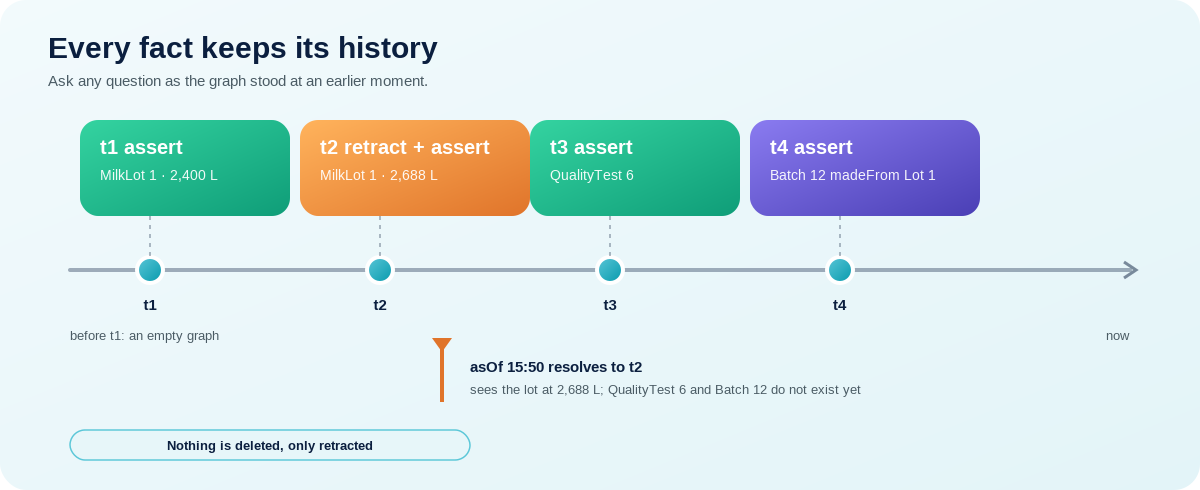
See Time travel.
Workspaces
Section titled “Workspaces”A workspace holds one team’s sources, models and graph. Requests name a workspace (the x-graphowl-workspace header), and what you can read is scoped to it. A workspace gathers many sources; add a new source to an existing workspace rather than making one workspace per source.
Ontology, vocabulary, entity
Section titled “Ontology, vocabulary, entity”Three things people often blur, kept apart on purpose:
| Question it answers | Example | |
|---|---|---|
| Vocabulary term | what do people here mean by this word? | “milk lot”: a quantity of milk collected together |
| Ontology class | what kind of thing is it? | MilkLot, with properties and relations |
| Entity | what actual things exist? | milk lot number 10 |
From a database to an ontology
Section titled “From a database to an ontology”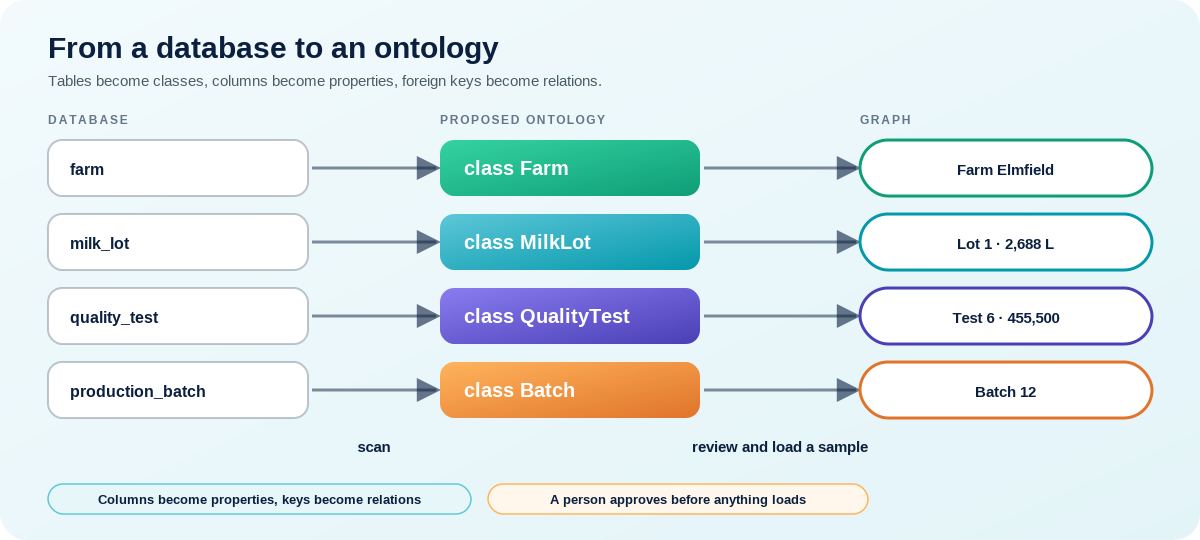
A pack is a bundle of ontology, glossary, rules and expectations for a domain. A data catalog, a compliance rule set or a dairy model is a pack. The same engine serves all of them. See Workspaces and packs.
Review before effect
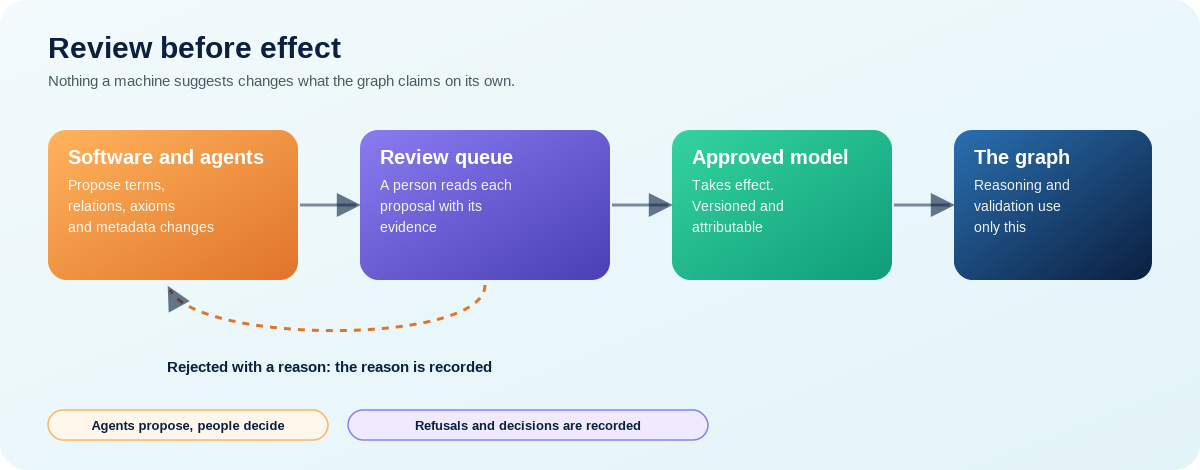
Section titled “Review before effect”Models proposed by software (for example, an ontology proposed from a database’s tables) are proposals until a person approves them. Nothing a machine suggests changes what the graph claims on its own.
Reasoning, and what “derived” means
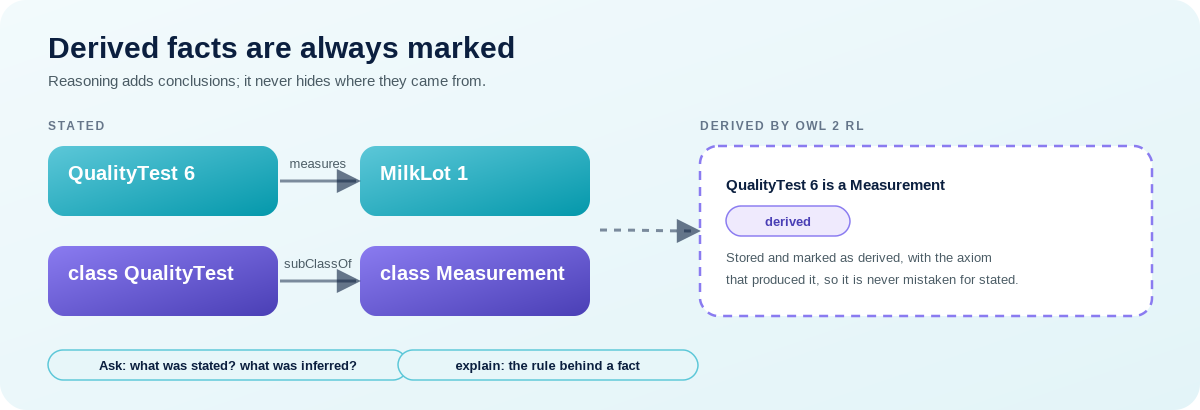
Section titled “Reasoning, and what “derived” means”OWL 2 RL reasoning works out what follows from the model’s axioms: if every QualityTest is a kind of Measurement, a quality test is also a measurement. Such conclusions are stored and marked as derived, so you can always tell what was stated from what was inferred.
Validation
Section titled “Validation”Constraints and quality expectations check data against the model and report what does not fit, without changing it.
Named graphs
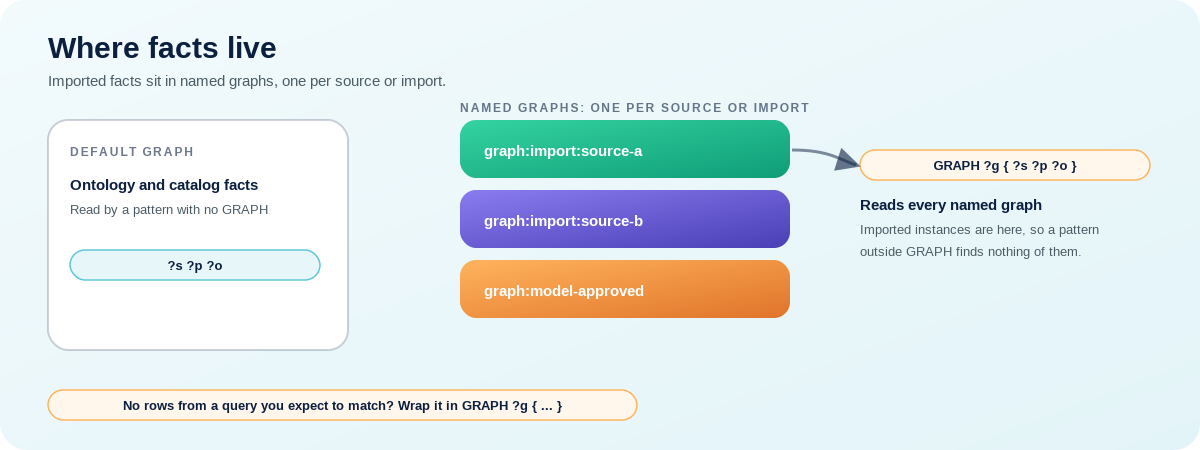
Section titled “Named graphs”Imported facts live in named graphs, one per source or import. A SPARQL pattern outside a GRAPH block reads only the default graph.
Virtual graphs
Section titled “Virtual graphs”A virtual graph asks a source database in place, through a mapping a reviewer approved, rather than copying its rows into the graph. See Virtual graphs.
Provenance
Section titled “Provenance”Every fact says where it came from: which source, which import, which person approved the model that gave it meaning.