

Time travel
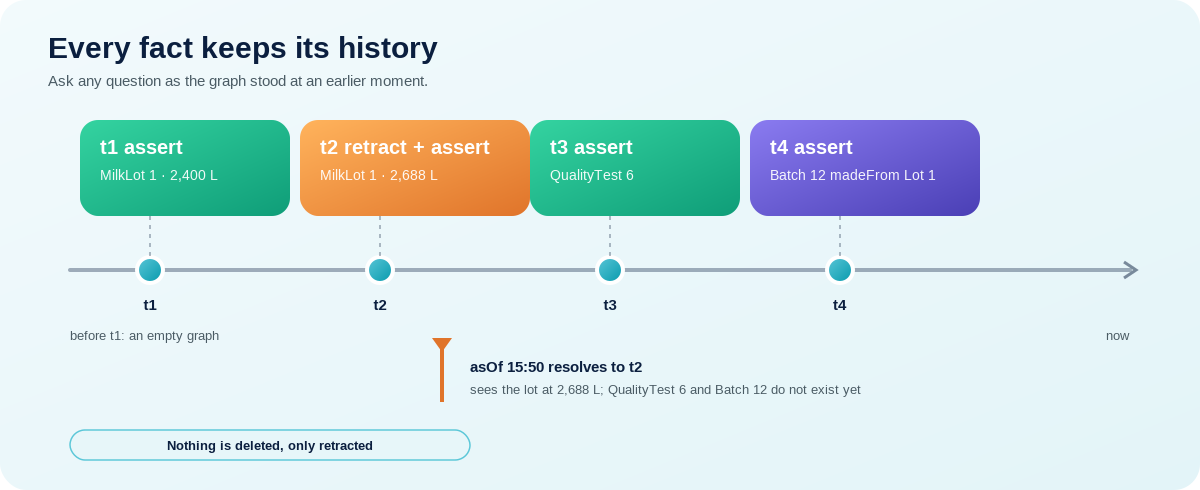
Add asOf (an RFC 3339 timestamp) to a SPARQL or openCypher request:
curl -X POST "$URL/sparql" \ -H "Authorization: Bearer $TOKEN" -H "Content-Type: application/json" \ -d '{"query": "SELECT (COUNT(*) AS ?n) WHERE { GRAPH ?g { ?s ?p ?o } }", "asOf": "2026-10-12T15:50:00Z"}'On the demo this returned 105 facts at 15:50, shortly after the load began, and 2,391 once it finished. The response’s asOf field is the transaction the timestamp resolved to (173 for that query).
Because facts are retracted rather than deleted, the earlier answer is exactly what the graph would have said then.
How a timestamp resolves
Section titled “How a timestamp resolves”A timestamp resolves to the newest transaction at or before it. Everything recorded in that transaction or earlier is visible; nothing later is.
Before the first transaction
Section titled “Before the first transaction”An instant earlier than the graph’s first transaction describes an empty graph, and the response reports asOf: 0. (Builds before this fix returned the present state for such an instant. If a server still does, it is running an older build: upgrade.)
What time travel covers
Section titled “What time travel covers”POST /sparqlandPOST /cyphertakeasOfin the body.- Graph traversal (the neighbourhood of an asset) takes
asOfas a query parameter. - A single asset can be read as it stood at a moment.
What it does not do
Section titled “What it does not do”It reads history; it does not rewrite it. There is no route that changes a past state.