

Agent patterns
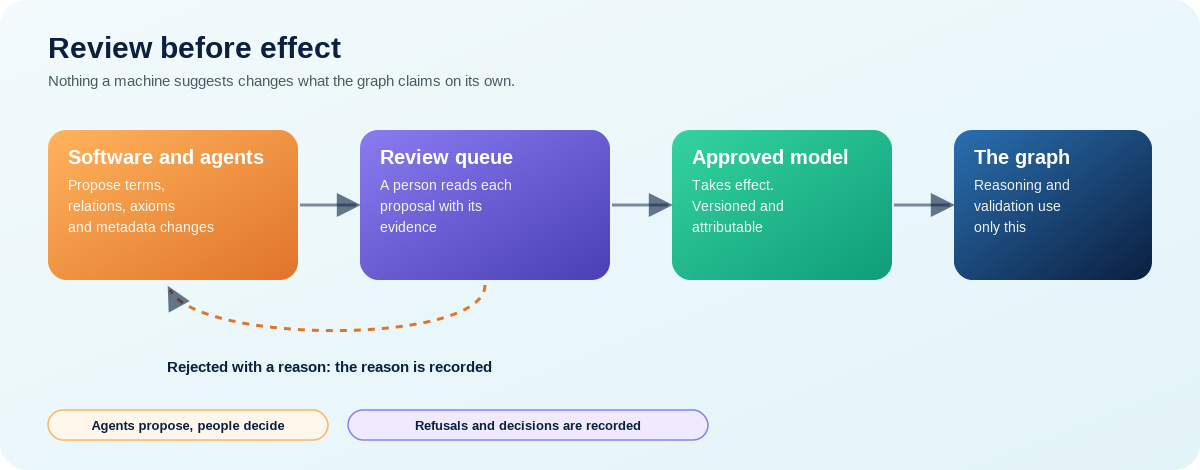
An agent that proposes, a human that approves
Section titled “An agent that proposes, a human that approves”Let the agent call propose_* tools (terms, relations, axioms, metadata changes). Each creates a proposal that appears in the review queue. A person approves or rejects it with a reason. An agent that cannot change what the graph claims, only suggest, is one you can leave running.
A loop that works:
search_assets/get_asset_contextto read what exists.query_graphto check a hypothesis against the data.propose_termsorpropose_relationswith the evidence it found.- A person reviews and decides (
decide_term,decide_relation); the agent can read the outcome next session.
Give each agent the least it needs
Section titled “Give each agent the least it needs”An agent’s grant lists the capabilities it may use (for example, record an investigation, propose a description). A call outside the grant is refused, and the refusal is recorded. Grant read-only agents nothing beyond reading. Grants are managed under /agents/grants.
Let it remember, on the record
Section titled “Let it remember, on the record”record_memory and record_investigation keep what an agent learned attached to the asset it concerned, with who wrote it and how sure they were. recall_memory returns those notes with the author, the confidence, whether the asset has changed since, and whether anyone disagrees. The next session starts informed instead of blank. See the agent memory cookbook.
Make answers traceable
Section titled “Make answers traceable”Prefer tools that return their evidence (explain, find_evidence, get_asset_context) and have the agent cite it. A derived fact is marked derived; an agent should say so rather than present it as stated.
Validate before it answers
Section titled “Validate before it answers”run_validation and list_findings tell an agent whether the data it is about to cite is currently valid, so it can say “this record has an open violation” instead of stating it as clean.
Scope by workspace
Section titled “Scope by workspace”Run an agent in a session scoped to the one workspace it serves, so it cannot read another team’s data.
What to avoid
Section titled “What to avoid”- Letting an agent write straight to the graph. Use proposals.
- One shared credential for every agent. Give each its own identity and grant, so a refusal or a bad proposal is attributable.
- Treating a memory as a fact. A memory is a claim with an author; the graph asserts only what a person approved.